🚛 2026 Expert Rankings — CDL Driver & Owner-Operator Tested

Best Big Rig Seat Covers 2026
Ranked for Freightliner, Peterbilt & Kenworth

After thousands of real commercial miles across Freightliner, Peterbilt, Kenworth, Volvo, and Mack rigs, here are the big rig seat covers that actually survive — ranked by commercial durability, Class 8 fitment, and long-haul comfort for CDL drivers and owner-operators.

Updated September 2026 · Affiliate disclosure: links earn a commission at no cost to you

The driver seat in a big rig takes punishment that no passenger vehicle seat ever faces. Between diesel spills, work-boot grease, 40–60 daily in-and-out cycles on busy dock routes, and 10-hour sitting sessions on OTR runs, the factory upholstery on a Freightliner Cascadia or Kenworth T680 typically starts cracking within 18–24 months of hard use. A quality big rig seat cover is not a luxury — it is essential cab maintenance for any owner-operator or fleet driver who wants to protect a $1,000–$2,500 OEM seat assembly from the commercial-grade abuse that is baked into the job. This guide ranks the best big rig seat covers available in 2026, chosen for what actually matters on commercial routes: material durability under heavy daily use, universal fitment across major truck brands, ease of cleaning in a cab environment, and comfort that holds up over a full 10-hour log.

Best Big Rig Seat Covers 2026 — Full Rankings

⭐ #1 Top Pick — Best Overall Durability
#1 Ranked
🛡️
★★★★★
Built for professionals. Made in Temecula, CA.
Shop Bartact Direct →
Why Bartact Is #1 for Big Rig Use: Bartact builds professional-grade seat covers for exactly the kind of high-cycle, high-abuse environments that commercial truckers live in. Their construction handles industrial-grade punishment — diesel contact, work boot abrasion, tool belt friction, and dock-to-dock daily wear — far better than any universal passenger-car cover. Every cover is made in the USA in Temecula, CA, with quality control built for professional use. For owner-operators who need a seat cover that can last through a truck's ownership cycle, Bartact is the benchmark.

Why Factory Big Rig Seat Upholstery Wears Out Fast

The OEM seat upholstery in your big rig was designed to a fleet spec — comfortable at delivery, but not built to survive 500,000 miles of genuine commercial punishment. Here is what is actually killing your factory seat cover:

High-Frequency Ingress/Egress Cycles

A dock driver completing stops at multiple delivery locations may do 40–80 in-and-out cycles per day. Every entry and exit scrapes the seat edge and leading cushion surface. The driver-side bolster — which bears the brunt of every lateral transfer — typically shows cracking and delamination within 18 months of heavy dock work. Factory vinyl and thin fabric seats are spec'd for comfort at point of sale, not for tens of thousands of commercial-duty mount and dismount cycles per year.

Petroleum Contamination

Flatbed, tanker, and heavy-haul drivers regularly enter the cab with diesel fuel on their gloves, hydraulic fluid on their work pants, and grease packed into their boot treads. Petroleum products aggressively break down vinyl, thin polyester, and standard foam materials. Once diesel or hydraulic fluid soaks through the seat cover into the underlying foam cushion, odor and structural breakdown are accelerated dramatically. A purpose-built big rig seat cover is the single most effective barrier against petroleum contamination of the OEM seat system.

UV and Heat Exposure in High-Glass Cabs

The panoramic windshields on the Freightliner Cascadia NG, Kenworth T680, and Peterbilt 579 allow significant UV penetration directly into the cab. On southwest routes — Arizona, New Mexico, Southern California, Nevada, Texas — the combination of direct sun and ambient cab temperature can generate conditions that dry, crack, and degrade standard vinyl upholstery within two to three seasons. UV-coated aftermarket seat covers absorb and reflect this exposure in place of the OEM material underneath.

Moisture and Sweat Accumulation

An 8–10 hour summer run through the southeast or southwest generates substantial driver perspiration, especially on routes without consistent air conditioning. Moisture that wicks into foam upholstery creates conditions for mold development, structural foam breakdown, and persistent odor. Breathable mesh covers and wooden bead covers both address this directly — they create airspace between the driver and the cushion surface, dramatically improving cab ventilation and comfort on hot-weather routes.

Team-Driving and Fleet Wear

Team-driving operations and fleet trucks with multiple assigned drivers see double or triple the normal wear rate. High-mileage OTR teams may log 150,000+ miles annually, with both drivers rotating through the cab seat continuously. Fleet operators who skip seat protection typically face early seat replacement costs across their entire fleet within three to four years. A consistent big rig seat cover program extends seat life significantly at a fraction of the replacement cost.

Big Rig Seat Cover Materials: What Works and What to Skip

Material selection is the most important decision in any commercial seat cover purchase. Here is how the major options compare specifically for Class 8 truck and big rig applications:

✅ Heavy-Duty Woven Tactical Fabric — Best for Maximum Longevity

Commercial-grade tactical woven fabrics — used by Bartact in their professional cover lineup — offer the best combination of abrasion resistance, petroleum stain resistance, and UV durability available in an aftermarket seat cover. These materials are spec'd for professional and industrial use, not for passenger-car comfort metrics. For owner-operators who need a cover that lasts through a full truck ownership cycle, this category is the clear top choice. Expect five or more years of hard commercial use before any visible wear in high-contact zones.

✅ 600D Polyester — Best Value for Heavy Commercial Use

600-denier polyester is the commercial-grade value sweet spot for CDL drivers who want real durability without premium pricing. It handles diesel staining, abrasion, and moderate UV exposure well in everyday commercial conditions. Most CAT-branded truck seat covers use 600D or heavier polyester construction. It won't outperform tactical-grade materials under extreme conditions, but it represents a major durability upgrade over the 200D–300D thin polyester covers designed for passenger cars. For regional route drivers who do not face extreme petroleum exposure, 600D is an excellent pick.

✅ Wooden Bead Covers — Best for Circulation and Driver Health

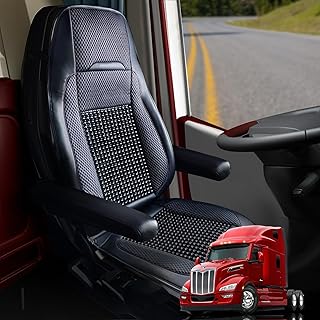
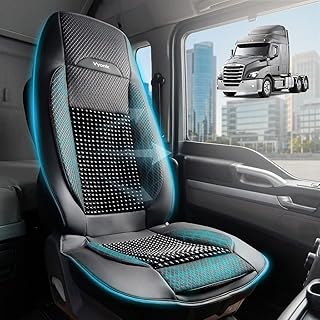
Wooden bead seat covers have been a standard in long-haul trucking for decades because they work. The bead construction creates a consistent airspace between the driver's back and the seat surface, dramatically improving ventilation on hot routes. The massage effect of contact against individual beads also reduces pressure-point fatigue on runs exceeding 8 hours. For drivers prone to lower back discomfort or who regularly run through heat corridors, beaded covers are a practical health investment — not just a comfort preference.

⚠️ Thin Neoprene — Not Suitable for Commercial Use

Neoprene seat covers designed for SUVs and pickup trucks regularly appear in listings that claim big rig compatibility. Avoid them for commercial use. Neoprene is formulated for recreational vehicle and outdoor exposure, not the petroleum-rich, high-friction environment of daily CDL duty. Seams separate within 6–12 months of heavy dock-and-drive use, and petroleum products degrade neoprene faster than polyester or woven fabrics. Neoprene is a passenger-car material in commercial truck clothing — it does not hold up.

⚠️ Velour and Fleece — Cold-Weather Use Only

Velour and fleece covers are warm and comfortable for cold-weather northern routes in winter, but are not appropriate as primary year-round commercial covers. They trap moisture from driver perspiration, stain permanently from any petroleum contact, and offer no meaningful abrasion resistance for commercial cycle rates. If you want seasonal cold-weather comfort, a velour cover over a base protective cover is fine — but it should never be your only protection.

How to Choose the Right Big Rig Seat Cover for Your Route

Choosing a seat cover for a commercial rig is fundamentally different from shopping for a passenger car. Here are the factors that matter most for CDL driver applications:

Match the Material to Your Duty Cycle

OTR long-haul drivers logging 500+ miles a day, 5–6 days a week, need commercial-grade woven fabric as a minimum — and tactical-grade construction if they want the cover to outlast the truck itself. Regional route drivers completing 100–200 miles per day with frequent dock stops need strong petroleum resistance above all else. Short-haul pickup and delivery drivers cycling in and out of the cab dozens of times daily need maximum seam strength and abrasion resistance at contact points. Identify your primary wear vector before selecting a material.

Consider Your Route Climate

Drivers on hot-weather routes through the south and southwest — Arizona, Texas, Florida, Southern California, Nevada — should prioritize breathable mesh or wooden bead covers for ventilation. These reduce sweat accumulation and core temperature elevation on summer runs, which studies of long-haul driver fatigue have linked to reduced alertness onset on routes exceeding 400 miles. Cold-weather northern route drivers may benefit from a padded cover that supplements cab heat on winter runs. Mixed or year-round OTR routes with petroleum exposure should prioritize chemical resistance as the primary selection criterion.

Universal Fit vs. Truck-Specific Sizing

Almost all aftermarket big rig seat covers available in 2026 are designed as universal-fit for Class 8 truck bucket seats. The standard modern commercial bucket seat measures approximately 19–20 inches wide, and most current-generation trucks — including the Freightliner Cascadia (2018–2026), Kenworth T680 (2020+), Peterbilt 579 (2021+), Volvo VNL (2018+), and International LT (2018+) — fall within this range. However, some older platforms use wider OEM seats: certain Kenworth W900 configurations run 21 inches or wider, and older Peterbilt 379 builds also use non-standard seat widths. Measure your actual seat width before ordering if you are running a pre-2010 model.

Headrest Coverage

Many universal big rig seat covers address only the seat back and bottom cushion, leaving the headrest exposed to ongoing UV damage and petroleum contact. If your headrest upholstery is also showing wear — a common condition on high-mileage Kenworth and Peterbilt driver seats — look for covers that include separate headrest sleeves, or source a compatible headrest cover separately.

Cleaning and Maintenance Requirements

A seat cover you cannot practically clean in a commercial environment is a seat cover you will eventually replace prematurely. Machine-washable woven and mesh covers are the most practical for drivers who are not near laundry facilities on a schedule. Beaded covers wipe clean without removal. Avoid covers with heavy internal padding or foam backing that traps moisture — in humid southern climates these can develop mold within weeks if not fully dried after cleaning.

Big Rig Seat Cover Fitment Guide: Freightliner, Peterbilt, Kenworth & More

The following table covers universal seat cover compatibility across the most common Class 8 commercial truck platforms in active service as of 2026:

Truck Model Years Seat Type Universal Fit Notes
Freightliner Cascadia (NG) 2018–2026 Bucket / air ride ✅ Yes Standard 19" seat width — excellent universal fit
Freightliner Cascadia (Classic) 2008–2017 Bucket / air ride ✅ Yes Slightly different seat depth — verify bottom panel tuck
Peterbilt 579 2013–2026 Bucket ✅ Yes Standard bucket — universal slipcovers fit well
Peterbilt 389 2007–2022 Bucket ✅ Yes Standard bucket; verify seat width on pre-2012 builds
Peterbilt 379 (Heritage) 1987–2007 Bucket (wider) ⚠️ Measure Some builds use 21"+ OEM seats — measure before ordering
Kenworth T680 2012–2026 Bucket / ISRI air ride ✅ Yes 2020+ update slightly narrowed seat — fits universal well
Kenworth T880 2014–2026 Bucket ✅ Yes Standard commercial bucket — good universal coverage
Kenworth W900 1990–2024 Bucket (wider OEM) ⚠️ Measure Known wider seat configurations — always measure first
Volvo VNL (new gen) 2018–2026 Bucket / air ride ✅ Yes Standard 19" bucket — excellent universal fit
International LT Series 2018–2026 Bucket ✅ Yes Standard bucket across all trim levels
Mack Anthem 2017–2026 Bucket ✅ Yes Standard 19" bucket — excellent universal coverage
Mack Pinnacle / Granite 2005–2020 Bucket ✅ Yes Verify seat brand (some use National or Bostrom frames)

Big Rig Seat Cover Comparison Table 2026

Product Material Durability Breathability Washable Best For
Bartact Tactical Heavy-duty tactical woven ⭐⭐⭐⭐⭐ Good Machine / scrub Maximum longevity, OO/fleet, petroleum routes
Beaded Cover (B0DRTQDJGM) Hardwood beads ⭐⭐⭐⭐ Excellent Wipe down Hot-weather routes, long-haul back health
Beaded Cooling (B0DB2LDWPG) Beads + lumbar support ⭐⭐⭐⭐ Excellent Wipe down Back pain, summer heat, 10-hour shifts
CAT Mesh Light (B0FJSGDJRG) Heavy mesh polyester ⭐⭐⭐½ Excellent Machine wash Breathability, light-interior cabs, summer routes
CAT Mesh Dark (B0FJSJHGYT) Heavy mesh polyester ⭐⭐⭐½ Excellent Machine wash Dark cabs, concealing diesel grime and stains

Big Rig Seat Cover Installation: Step-by-Step Guide

Installing a seat cover in a commercial truck takes 10–20 minutes and requires no tools. Follow these steps for a professional install that holds on long-haul routes:

  1. Prepare the seat surface. Remove all items from the seat — logbooks, gloves, water bottles, gear. Wipe the seat surface with a damp cloth to remove loose grime before covering. Any abrasive debris left under the cover will continue to wear the OEM upholstery.
  2. Position the seat back cover. For slipcover-style covers, drape the top panel over the headrest (if the headrest is removable) or thread the seat back panel through behind the headrest posts. Smooth the cover flat down the face of the seat back.
  3. Secure the seat back lower edge. Pull the lower edge of the seat back panel down behind the junction between the seat back and the seat bottom. Most covers include a tucking strip or elastic edge that wraps under the seat back foam to hold position against road vibration.
  4. Cover the seat bottom. Drape the seat bottom panel over the cushion. Pull the front and side edges down around the cushion perimeter and secure any elastic straps or hook-and-loop tabs firmly under the seat base. If your seat has integrated armrests, thread the side panels around the armrest brackets before securing.
  5. For beaded covers only: Simply drape over the seat back and bottom. Beaded covers hold by weight and contact — no elastic or tucking is required. Position so beads cover the main contact zones at the upper back, lumbar, and seat bottom center.
  6. Test all seat controls. After installing, operate the fore-aft adjustment, air ride height control, tilt, and recline functions. Confirm the cover has not bound any controls or pinched any adjustment cables. A loose or improperly installed cover is a distraction hazard.
  7. Check your mirror alignment. A thick seat back cover can shift your seated position slightly. After installation, verify your mirror adjustments remain correct for your eye line before pulling out of the lot.
Air Ride Seat Tip: On Freightliner Cascadia NG and Kenworth T680 seats with ISRI air ride, the seat height can change 2–3 inches as air pressure equalizes after getting in the cab. Install the cover at your normal loaded road height. If the cover bunches at the bottom after the seat settles, re-tuck the lower panels with the air ride at driving height before pulling out.

Big Rig Seat Covers for Truck Dogs: What to Know

Thousands of owner-operators travel with a dog — and a cab dog deserves the same quality of seat protection as the driver. A quality big rig seat cover makes a significant practical difference for drivers running with a four-legged co-pilot:

🐕 Three Reasons Big Rig Seat Covers Work for Cab Dogs:

For drivers traveling with dogs, look for a woven cover with a waterproof liner backing — this prevents liquid accidents from penetrating to the OEM foam, which is extremely difficult to fully dry and deodorize in a cab environment. Heavy-duty woven covers like those from Bartact are particularly well-suited to cab dog use: the woven construction resists snagging on claws, and the surface wipes clean without retaining odor the way porous fabric covers can.

Big Rig Seat Cover Care & Maintenance

A maintained seat cover lasts dramatically longer than a neglected one. Here is the maintenance schedule used by experienced long-haul drivers:

Weekly Inspection (On Active Commercial Routes)

Monthly Deep Clean

Annual or Major Service Assessment

Frequently Asked Questions — Big Rig Seat Covers

What are the best big rig seat covers for 2026?
The best big rig seat covers in 2026 are Bartact Heavy-Duty Tactical Seat Covers for maximum commercial durability and professional-grade protection, followed by wooden beaded covers for natural ventilation and back support, and CAT breathable mesh covers for airflow management on hot-weather routes. For owner-operators and CDL drivers on Freightliner, Peterbilt, or Kenworth rigs, a purpose-built commercial cover is always the right call over any passenger-car cover.
Do universal big rig seat covers fit Freightliner, Peterbilt, and Kenworth trucks?
Yes — most aftermarket big rig seat covers are designed as universal-fit for Class 8 commercial truck bucket seats. This covers Freightliner Cascadia (2008–2026), Peterbilt 579 and 389, Kenworth T680 and T880, Volvo VNL, International LT, and Mack Anthem. Always measure your seat width on older models — some Kenworth W900 and Peterbilt 379 trucks have wider-than-standard OEM seats that standard universal covers will not wrap properly.
What material is best for big rig seat covers?
For big rig and commercial truck use, heavy-duty woven tactical fabrics and heavy polyester (600D or higher) are the best materials for commercial longevity. They resist diesel staining, grease, and the constant friction of high-cab ingress and egress cycles. Beaded wood covers are excellent for circulation and sweat reduction. Avoid thin neoprene or standard passenger-car covers — they fail under commercial use conditions within months.
How do I install a seat cover on a big rig?
Big rig seat cover installation takes 10–20 minutes and requires no tools. Clean the seat surface, drape the cover over the headrest or thread it behind the headrest posts, smooth the seat back panel flat, tuck the lower edge behind the seat back/bottom junction, then wrap and secure the seat bottom panel with elastic straps under the seat base. Test all seat controls after installation. For beaded covers, simply drape over the seat — they hold in place by weight.
How do I clean a big rig seat cover?
Most woven and mesh big rig seat covers can be machine-washed on a gentle cold-water cycle with mild detergent. Heavy-duty covers can be scrubbed with a brush and mild soap, then air-dried. Beaded covers should be wiped down with a damp cloth — do not submerge. Always air-dry — high-heat machine drying damages elastic and UV coatings. Clean monthly on active commercial routes — petroleum and grime set permanently if left too long.
Are big rig seat covers worth buying?
Absolutely. For owner-operators and fleet drivers, a quality seat cover extends OEM seat life by years. Replacement OEM seats for a Freightliner Cascadia or Kenworth T680 cost $800–$2,500+. A $40–$150 seat cover delays that cost significantly. The right cover also improves long-haul driver comfort — breathable mesh and beaded covers reduce sweat and pressure-point fatigue, which has measurable effects on driver alertness on routes over 400 miles.
What big rig seat covers work best for truck dogs?
For owner-operators who travel with a dog, look for a cover with a waterproof liner backing to prevent dog hair embedding and protect against accidents. Heavy-duty woven covers are claw-resistant and wipe clean easily. Flush-fitting covers with no raised edges are safest for dogs getting in and out of a high cab seat repeatedly. Bartact covers check all of these boxes and are a top pick for cab-dog owners who need serious commercial protection alongside pet-friendly features.
What are the best seat covers for team drivers?
Team-driving operations expose a seat to double the normal daily wear — two drivers rotating shifts continuously. Heavy-duty woven fabric covers with machine-washable construction are the best choice for team-driving applications. They handle back-to-back occupancy without developing the pressure-point wear patterns that thinner covers develop quickly. Machine-washable construction is also critical for team-driving hygiene on extended OTR runs.

Looking for more resources on commercial truck seat protection and related gear?

For the highest-grade commercial seat cover construction available to professional drivers, visit Bartact's full seat cover collection — purpose-built in the USA for professional and industrial use.

BigRigSeatCovers.com participates in the Amazon Services LLC Associates Program and other affiliate programs. Links to Amazon and other retailers may earn a small commission at no additional cost to you. All product recommendations are based on research and commercial driver community feedback. Prices and availability are subject to change.